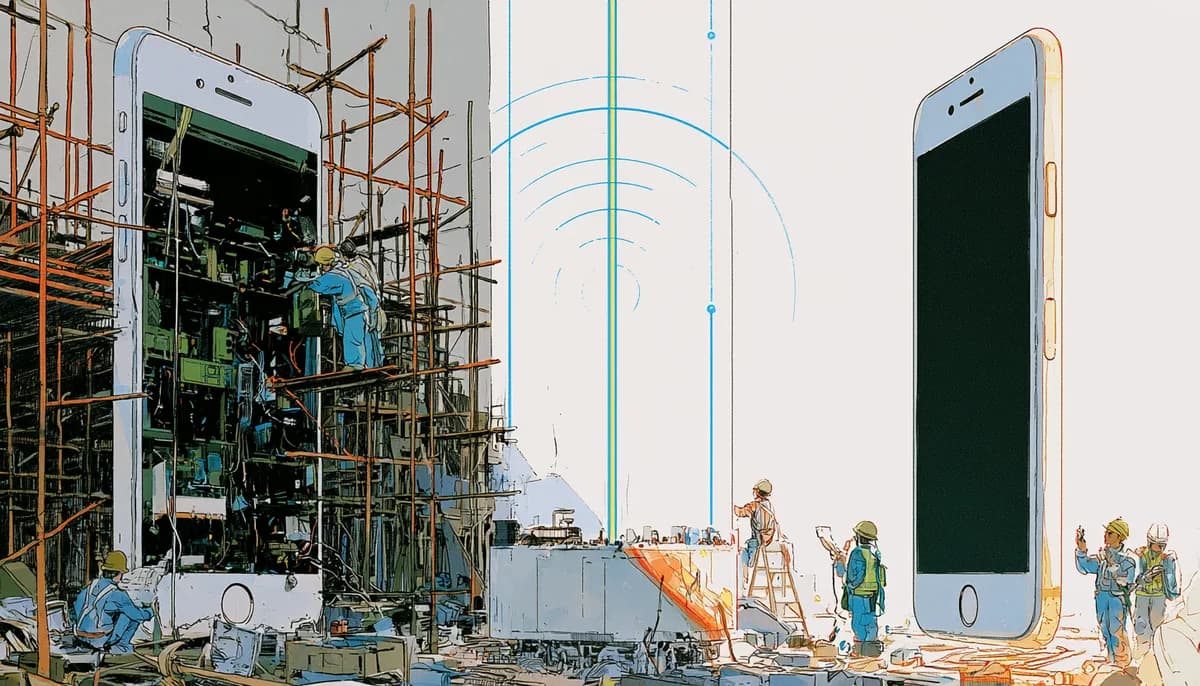

Your subscribers compare you to RingCentral, Vonage, and every UCaaS provider with a polished mobile experience. If you hand them a generic SIP client, or no mobile app at all, you lose revenue every month you wait.
Here is how to calculate the actual return on launching a branded mobile app.
What VoIP Operators Lose Without a Branded Softphone
The biggest cost is not what you spend. It is what you lose.
Subscriber churn. When a customer's mobile experience is clunky, they do not call support. They switch providers. UCaaS competitors spend millions making switching easy. Every subscriber who leaves takes their monthly ARPU permanently.
Support burden. Generic SIP clients generate 3–5x more support tickets than purpose-built apps. "Why aren't my calls ringing?" is the number-one ticket for operators without proper push notification infrastructure. Each ticket costs $15–25 in staff time.
Brand invisibility. If your subscriber uses a third-party dialer, they associate their calling experience with that app, not your service. You become invisible infrastructure with zero brand loyalty.
Competitive disadvantage. RingCentral, Dialpad, and Vonage all ship branded mobile apps by default. If your subscribers' employees are comparing experiences, you lose before the conversation starts.
Legacy lock-in. Some operations run on legacy desk-phone infrastructure that ties daily calling to the old system: hospitals, hotels, and prisons can't simply let phones go dark. The real cost of standing still is often not budget but not knowing how to move without breaking calls. A guided migration keeps that switch simple.
What a Branded Mobile App Actually Costs a VoIP Operator
Three routes exist. The economics differ dramatically:
| Route | Setup Cost | Monthly Cost | Timeline | Team Required |
|---|---|---|---|---|
| White-label (Cloud Softphone) | ~$5,000 | ~$600/mo + per user or per usage | 2–4 weeks | None |
| SDK-based custom | $30K–$80K | Maintenance | 2–6 months | 2–3 devs |
| Build from scratch | $500K–$1M+ | ~$1.02M/year (8-person team) | 13–35 months | 8+ engineers |
The setup figures alone span more than two orders of magnitude. Plotted on a log scale, the gap between routes is hard to ignore:
The build route sounds appealing until you do it. Push certificate management alone (FCM + APNs, rotating credentials, handling OS-level changes every year) is a full-time job. Add codec licensing, quarterly OS compatibility updates, and you are maintaining infrastructure instead of serving customers.
The white-label route gives you a branded app in your app store listing (your logo, your colors, your provisioning) without building and maintaining it in-house. The bar to write code keeps dropping, but shipping and supporting a production softphone year after year still costs real money, time, and dedication. The Build vs Buy ebook runs the full numbers on both routes.

How a Branded App Grows VoIP Revenue
A branded app drives revenue in four ways:
1. Churn reduction. Mobile-first subscribers show 20–30% lower churn than desktop-only users. Even a conservative 5% reduction compounds fast.
2. Premium tier upsell. Subscribers who use your app daily are more likely to upgrade to higher-tier plans. They see your brand multiple times per day, marketing you do not pay for.
3. Lower support costs. Three-layer push notifications (FCM + APNs + Local Push) mean calls ring reliably. Push delivery is handled by SIPIS, Acrobits' proprietary push infrastructure (operational since 2009), which maintains a persistent SIP instance server so calls ring on subscribers' devices regardless of which softswitch you run. Operators typically report a 40–60% reduction in call-delivery support tickets after deploying proper push.
4. Competitive positioning. A branded mobile app puts you in the same conversation as UCaaS providers. Without one, you are eliminated before the demo.
A Simple ROI Framework for Branded VoIP Apps
Net Annual Gain = (Subscribers Retained × ARPU × 12) – Annual App Cost
Example: 2,000 subscribers at $30 ARPU. Current churn: 15% (300 lost/year). After branded app: 12% (240 lost/year). That is 60 retained subscribers, saving $21,600/year. App cost: $5K setup + $600/month = ~$12,200/year. Net ROI: $9,400 (77% return).
At 5,000 subscribers the net ROI jumps to $43,000/year. The app pays for itself within four to five months.
Time to Value for VoIP Operators
Unlike building from scratch (13–35 months), the white-label path delivers impact fast:
- Week 1–2: Branding, configuration, provisioning setup
- Week 3–4: App store submission and approval
- Day 30: First subscribers onboarded, push working, calls ringing
- Day 60: First measurable churn reduction data
You know whether it works within 60 days, not a year.
Breakeven Lands at Just 28 Subscribers
The question is not whether a branded mobile app has ROI. It is how much revenue you lose every month without one. From roughly $10K/year all-in, the breakeven point is retaining just 28 subscribers at $30 ARPU — under 3% of a 1,000-subscriber base.
- ~28 retained subscribers cover the app
- Rest of a 1,000-subscriber base
The Offensive Play: In-App Revenue Tabs
Churn reduction is the defensive ROI. There is also an offensive play.
Cloud Softphone's custom web tabs let operators embed upsell offers, billing portals, plan upgrade pages, and promotional content directly inside the app, without triggering an app-store review. Operators can stand up a revenue-ready tab in minutes, and the 11 documented use cases are included free in White Label bundles.
This turns every call into an engagement touchpoint and every subscriber session into a potential upgrade event. See 6 Ways to Monetize Cloud Softphone for more revenue plays.
Turn calls into revenue
Learn how to monetize your softphone with in-app web tabs, fast, elegant, and low-code.
- Works on iOS, Android, and desktop
- Unlock new in-app revenue streams
- 100% free to download