
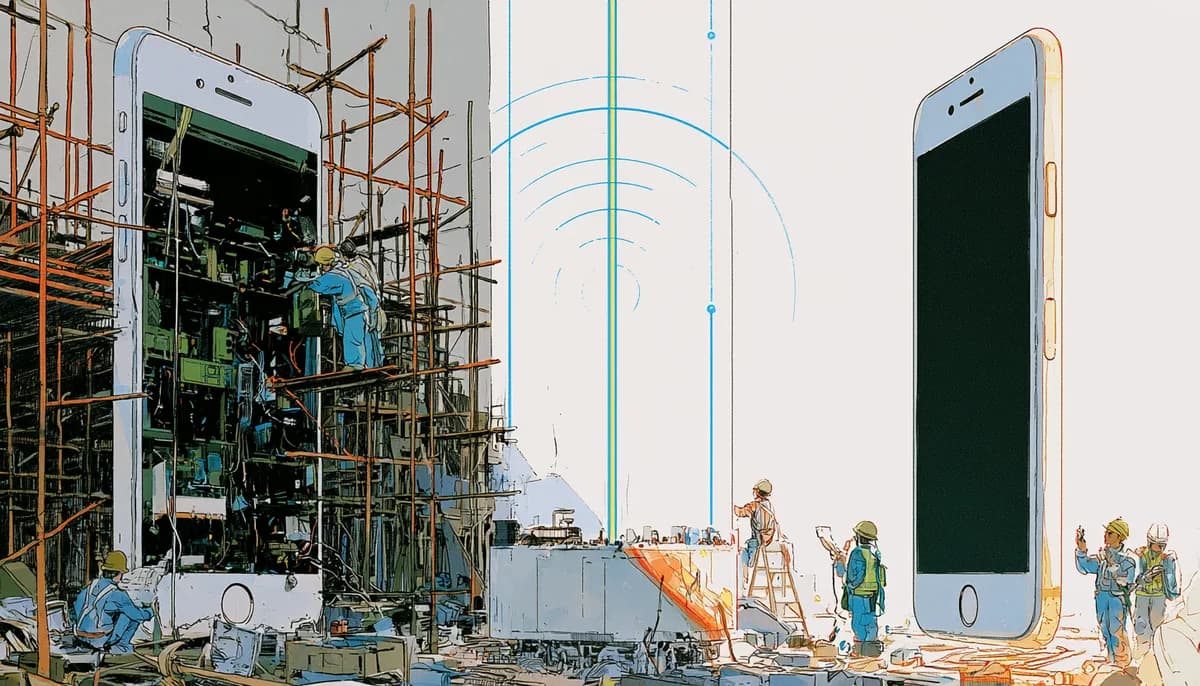
The big carriers have left a market behind, and an operator has built a business on it. That market is a rural community, or an industry the operator knows better than anyone larger.
A request lands on its desk. Customers want the office phone on their staff's mobiles, under the operator's own name.
The first instinct is to price a build against a purchase. The trade's umbrella for operators like that is alternative telecom carrier.
Price matters, and it lands better a little later. We suggest an operator walks a path of stations first. Each one clears something the app has to do, and the softphone still standing at the end is the one worth pricing.
The law along the way is US law. We note the UK and the EU where they differ.

Who the alternative telecom carrier is
No regulator defines the term. We went looking for one and found an editorial umbrella over several legal categories. In the US, 47 U.S.C. 251 fixes the incumbent to whoever served an area on 8 February 1996, and a CLEC is any local exchange carrier that is not that incumbent.
| Sub-industry | What the subscriber pays for | The requirement that decides the app |
|---|---|---|
| Competitive fibre and CLECs | Fixed broadband with a voice line on it | Dispatchable location on 911, and a switch the app can outlive |
| Rural and independent LECs | Local access and a number the household has held for years | Portability in both directions, and push and codec work a small team can carry |
| Wireless ISPs | Fixed wireless access, often the only link in the area | Low-bitrate codecs and NAT traversal that hold a call on a thin pipe |
| Municipal and cooperative broadband | Community-owned access with voice as an add-on | A listing published under the network's own name |
| Cable operators adding voice | Voice bundled with broadband and TV | Interconnected VoIP duties met through the app |
| MVNOs | Mobile service on a host network, often prepaid | Balance, top-up and callback, under a brand the host does not own |
What the regulator makes your app do
The rulebook reads heavier from outside than it turns out to be. It comes down to four duties: emergency location, text to 911, caller ID signing and lawful intercept, and keeping the number.
All four attach to you rather than to the app vendor.
Two of them are met in the app, and a carrier-grade client carries them already. The other two live in the network, where the app stays out of the way. The FAQ below carries the rule numbers.
- Emergency location, the E911 duty. Fixed interconnected VoIP has to deliver the caller's location automatically with a 911 call. Non-fixed service falls back to a Registered Location the subscriber can update, and the app is where they update it.
- Text to 911, real-time text or RTT. A voice over IP provider can meet its 911 access duty with RTT instead of TTY, and RTT belongs in the client.
- Caller ID signing and lawful intercept, STIR/SHAKEN and CALEA. The FCC's call authentication rules bind the originating provider at network level, and the FCC says the act covers interconnected VoIP. Both live in the network. The app plays no part.
- Keeping the number, number portability. In the US a simple port has to complete within one business day, and Ofcom describes the same facility in the UK. The app does nothing here.
In the EU the emergency duty is access to 112. The rest differs by country, and we did not chase every one. The port clock runs both ways for a rural LEC, which can gain a number in a day and lose one in a day.
Nothing in the four ties you to a particular switch, or waits on a vendor decision, which is just as well, because switches change hands.
Any switch, and the freedom to change it
What happened to the backend market was seismic. Cisco completed its BroadSoft acquisition on 2 February 2018, Crexendo closed its NetSapiens merger in June 2021, and Alianza completed its purchase of Metaswitch from Microsoft on 4 March 2025.
Three of the platforms an operator could have built on in 2017 answer to a different owner today. There are fewer platforms now, owned by larger companies, and their roadmaps are written further away from the carriers running on them.
Nobody picks a switch expecting to change it, and for a long stretch nobody had to. Then the ownership changed, and operators found out quickly which parts of their service could move and which were welded down.
The subscriber app was often the welded part, because it had been built against one vendor's stack, and moving it turned into a project rather than a decision.
A softphone that registers against any standards-compliant SIP backend survives a change of switch without a redeploy. That is the part that travels through a change of owner.
Cloud Softphone is that kind of generic SIP client. Its compatibility list runs from Metaswitch and BroadSoft to Asterisk and 3CX.
Where a switch offers more than SIP, the app takes it, as the BroadSoft XSI integration shows.
For operators running Metaswitch, Alianza acquired Metaswitch: what operators need to know covers keeping the subscriber app steady through the change of owner.
Thin pipes and small teams
The codec sets the bandwidth floor. On a fixed wireless link that floor is what decides whether a call holds together at the busy hour.
Opus goes lower still and conceals lost packets. G.729 Annex A ships in every Cloud Softphone bundle, provided the carrier's SIP side supports it.
Getting media through the subscriber's router is the app's job, not the carrier's.
How big is the team running it?
WISPA's 2024 member survey is the one staffing source we found, after three research passes came back with nothing else. It says more than 60 percent of respondents have five or fewer full-time employees, and more than 84 percent have 25 or fewer.
Whatever a team that size chooses, the network side of push stays with it. Mobile operating systems block background networking, so SIPIS holds the registration and wakes the app when a call arrives. Two things stay on the carrier's side:
- The PBX is reachable from the public internet.
- The SIPIS addresses are on the registrar's allowlist.
The push setup notes cover both, and neither waits on a choice of app.
Prepaid subscribers and diaspora MVNOs
Prepaid means real-time charging. Balance display, in-app top-up, per-minute rates and callback belong to international calling operators, calling-card businesses and prepaid MVNOs. Telinta and PortaOne describe those flows in detail in their own documentation.
In Cloud Softphone they are provisioning options, not custom builds. Balance checking and web callback run as custom web services whose URLs the operator sets in the portal.
The web page where people already managed their account now lives inside the dialer. Balance and usage are right there, no separate login, no separate app. A data-only MVNO on the same problem. The story is here.
Before you can text anyone
Messaging in the US arrives with registrations attached. Application-to-person SMS on a ten-digit long code needs brand and campaign registration through The Campaign Registry before carriers carry the traffic.
Carriers have blocked unregistered 10DLC traffic since February 2025, and since December 2025 new 10DLC numbers arrive with messaging disabled until someone registers them. That queue runs on someone else's clock, so it is worth joining early.
Some backends carry on-net messaging out of the box, and the Turnkey Messaging requirements name them. Everywhere else Linkup asks the carrier for four pieces of setup.
Whose brand, whose customer

Vendors describe one pattern, and we found no independent study of it. A multi-tenant platform carries many brands at once, and the customer relationship follows the brand rather than the platform underneath it.
In a reseller or agent program the app and the store listing belong to the vendor, and the resellers post draws the line from there.
White Label produces an app rebranded to the operator, published under the operator's developer account and findable under its brand. The generic Cloud Softphone app ships under the Cloud Softphone name and shows operator branding only after provisioning.
If the subscriber finds the listing under your developer account, it is yours.
One master white-label app, on our own developer accounts, and inside it, each property gets its own logo, color scheme, app name, splash screen, even its own tab order. A regional carrier running ten hotel brands. We wrote it up.
Build or buy: the cost case behind the best softphone options for alternative telecom carriers
We looked for an independent number and there is none. Every softphone-specific cost or timeline figure in circulation comes from a vendor selling the alternative, ours included. The figures live in the ROI of a branded mobile app.
Acrobits publishes its white label pricing, so the buy side is a page you can read rather than a quote you have to request.
What's the cost of a custom softphone?
Build vs buying a softphone. What's the best pick in 2025?
- Full cost breakdown
- Details on both routes
- 100% free to download
The 90-day picture
Ninety days is a frame, not a promise, and no two carriers spend it the same way. Still, the order is recognisable. The early stretch is the carrier's own and waits on nobody: a reachable PBX, the SIPIS allowlist, the emergency-location duties. Registrations go in alongside them, on a clock that is not yours. The store review lands wherever the stores put it.
After that it goes quiet. Once the app is in the stores, configuration changes ship through provisioning without a rebuild, while branding and platform additions need a new build and another review.
A support desk will meet three limits, and they land better now than at launch. The FAQ names all three.
Your requirements choose the route before your budget does. Pass every station and the choice left over is a small one.
Build a white label softphone app
Create a custom white-label softphone with Cloud Softphone.
- No devs needed
- Native desktop apps
- 100+ premium features