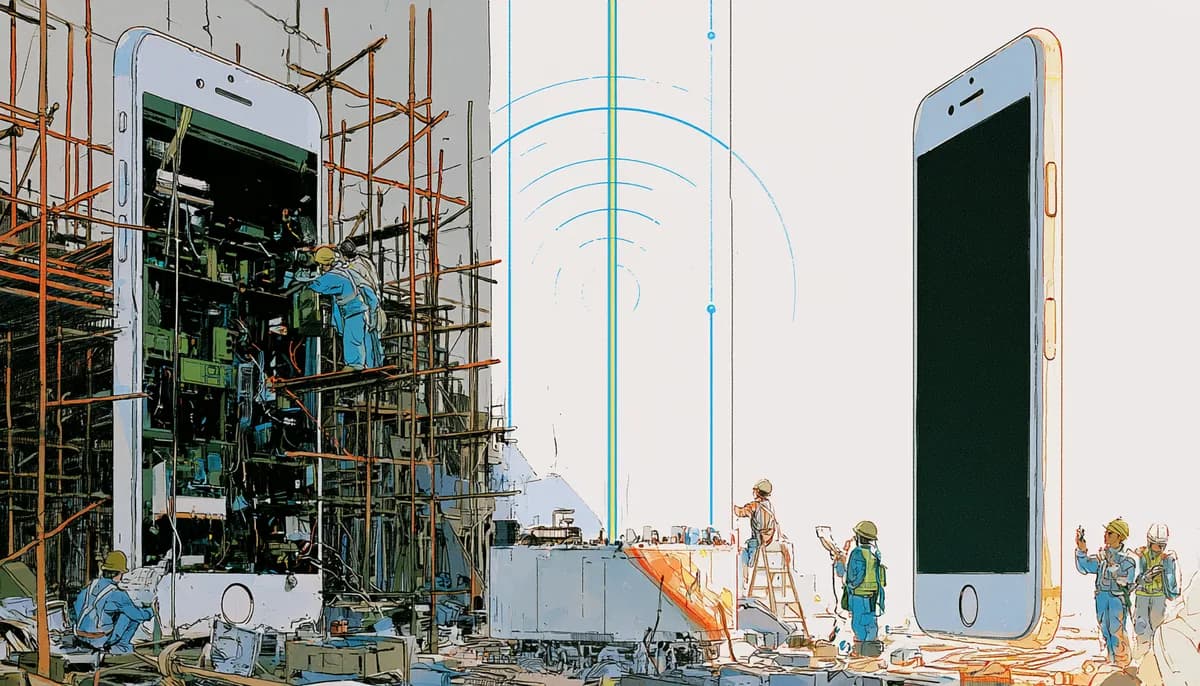

You can have a working softphone running against your own SIP backend, on a real phone, before you sign anything. No contract, no purchase order, no Apple Developer account, no app store submission. Download the generic Cloud Softphone app from the App Store or Google Play, enter a Cloud ID, and you are on your own build.
That part is easy, and most vendors will give you something similar. The harder question is what you do with it, because a softphone trial that anyone can pass is a trial that proves nothing.
How a softphone trial works
The generic Cloud Softphone app is already published in both stores. You do not build anything to test; you borrow ours. That holds whichever way you are leaning on the white label or generic softphone choice from chapter one. When a tester provisions the app, it pulls your configuration and becomes your softphone: your features, your backend, your SIP accounts, your branding once the initial provisioning completes.
There is one detail worth getting right before your testers start, because it catches people. A Cloud ID entered with an asterisk points at the editable sandbox version of your build. The same ID without the asterisk points at the live version. One character decides whether a tester is exercising the configuration you are still changing or the one your future subscribers will get. Tell your team which one they are on. This is the single most common source of confused trial feedback.
Desktop works the same way. The macOS and Windows binaries come from the dashboard at providers.cloudsoftphone.com rather than the public stores, but the provisioning flow is identical.
Timing is unremarkable, which is the point. A trial usually starts within days of the discovery call, sometimes after one short follow-up to settle open questions. There is no build queue to wait in.
What you are not testing
This matters more than the list of what you are, so here it is plainly.
You are not testing your app store listing. During a trial the app is under our name in the stores, and your branding appears after provisioning rather than on the listing page. Screenshots, store description, review process, and the icon a subscriber taps on their home screen all belong to launch, and none of it can be rehearsed in a trial.
You are not testing publication. Whatever you learn about Apple's and Google's review behaviour, you will learn it at launch and not before. That is a real problem, and it belongs to chapter three, on the softphone launch timeline.
You are not testing at subscriber scale unless you choose to, and that is easy to set up. A trial with six internal testers tells you the features work. It tells you very little about what happens when four thousand handsets register on a Monday morning.
Everything else, the part that usually decides the deal, is available immediately and behaves exactly as it will in production.
The month is a support window, not an access window
We tell people they have a month. That number describes our attention, not your access.
For that month you can get a dedicated Slack channel and direct contact with the people who build and deploy this software, rather than a ticket queue. Ask why a registration is failing and an engineer answers, usually the same day. That is the resource with a deadline on it, and it is the reason we put a number on the trial at all.
Access itself stays open. You can keep testing on the generic app for as long as you find it useful, and some people do, returning months later when a project gets funded. Nobody switches you off.
So use the month for the questions that need us, and leave the slow poking around for afterwards.
The failure mode nobody plans for
Trials rarely fail because the software fails. They fail because nobody wrote down what the trial was supposed to settle.
The pattern is consistent enough to predict. A team installs the app, makes a few calls, agrees it seems fine, and then stalls for six weeks because nobody can say whether "seems fine" is a yes. Meanwhile someone in the room who never spoke up has an unstated requirement, usually about voicemail behaviour or a specific desk phone that has to keep working. It surfaces in week five and reopens the whole discussion.
The fix is unglamorous. Before the trial starts, write down the things that would make you say no. Not the wish list; the disqualifiers. Three or four sentences is enough.

A useful version looks like: our field engineers must be able to use the mobile app in places with weak reception and low bandwidth; call history must survive a reinstall; the app must register through our existing SBC without opening a new port. Each of those is checkable in an afternoon, and any one of them coming back wrong is a real answer.
Compare that with "evaluate whether Cloud Softphone meets our needs," which is not a test. It is a way of postponing a decision while looking busy.
Write the disqualifiers, run them in the first week, and spend the remaining three weeks on the interesting questions rather than rediscovering that the app makes calls.
What the trial is really for
There is a reason we hand over a working build before any money moves, and it is not generosity. A softphone deployment touches your switch, your provisioning, your support team, and eventually every subscriber you have. Nobody should commit to that on the strength of a demo. We would rather find out in week one that something in your stack behaves oddly than in month four, with a launch date already announced.
Which reframes the question worth asking any softphone vendor. Not whether they offer a trial, because everyone says yes. Ask what you can actually run during it, how long their engineers stay reachable, and what they will not let you test.
The answers to that last one tell you the most.
Build a white label softphone app
Create a custom white-label softphone with Cloud Softphone.
- No devs needed
- Native desktop apps
- 100+ premium features