Cloud Softphone Technical Buyers Guide
Download the complete guide on choosing the best features for your business.
- Detailed visuals
- Full feature breakdowns
- 100% free to download


| Audience | What to focus on |
| Business leaders | Business leaders: Treat voice like a product, not a utility. Fund verified identity, branded calling, and in-call AI that moves AHT, FCR, and answer-rate. |
| Engineers | Build SIP and WebRTC stacks with analytics APIs, fraud and identity checkpoints, and edge AI in mind. SIP + AI is one stack now. |
| End users | Expect clearer calls, fewer scam calls, and voice that just works inside whatever app you’re already using. |
The price story is over. The growth story starts when calls create data you can act on, summaries, intents, verified identity, and those signals improve sales, CX, and fraud loss every quarter.
Both market forces and the growth of business communications will help create this momentum.
The global VoIP market is projected at roughly $160+ billion in 2025, with an expected ~11 percent compound annual growth rate through 2034, driven by cloud delivery, SIP trunking, and mobile-first deployments. Precedence Research tracks this as continued expansion, not a mature plateau.
To put things into perspective, Cloud Computing ($781 Billion to $943 Billion) is 5x to 6x larger than the VoIP market. Cloud Computing is a vastly larger infrastructure market, but VoIP is a critical service running on top of the cloud.
Video Game Industry ($189 Billion to $303 Billion), comparable to the VoIP market, though some sources project the video game market to be up to 2x larger. This shows VoIP is in the same economic league as global entertainment.
Enterprise Networking (Networking $87 Billion to $141 Billion) – slightly Smaller than the VoIP market. Enterprise Networking (hardware like switches, routers, and Wi-Fi) is the physical infrastructure, while VoIP is the key application for that infrastructure.
At over $160 billion, the VoIP market is massive, actually much bigger than the “core hardware industry” (Enterprise Networking) that physically enables it.
As identity, analytics, and CPaaS converge, voice behaves more like cloud software than telephony. That puts it between slow legacy telco and hypergrowth AI infra, an expandable middle lane.
The transition is well underway, and the divergence will continue to intensify.
CPaaS, short for the buzzword Communications Platform as a Service (CPaaS), offers APIs for voice, messaging, and video embedded in apps, and is expanding rapidly.
Just like setting up Wi-Fi or installing software went from a technical headache to a one-tap experience, CPaaS is doing the same for communications.
What once required SIP experts, custom servers, and months of integration is now achievable with a few API calls. This shift is removing barriers for product teams and accelerating time-to-market for enterprises that want to embed calling, messaging, or authentication directly into their apps, without becoming telecom companies themselves.
And the long-term vision is clear: a true one-stop shop where the entire communication stack-voice, messaging, video, and identity-is fully programmable, deeply integrated, and effortless for the businesses that need it.
Mordor Intelligence describes CPaaS as transitioning from a ~$20B class market in 2025 toward aggressive multi-year expansion at roughly a 30 percent CAGR, as enterprises shift from buying “phone systems” to purchasing programmable, easy-to-configure communication.
Analysts tracking UCaaS and CPaaS in 2025 say the growth story has changed; it’s no longer about adding “more seats” or “more minutes.”
The focus is now on AI: smarter calls powered by transcription, coaching, fraud detection, and contextual routing.
Gartner’s UCaaS trend coverage in late 2025 highlights generative AI as the biggest differentiator, enabling live transcription, translation, and real-time coaching, and predicts enterprise-wide rollout as the tech matures.
Additionally, IDC’s 2025 CPaaS MarketScape shows providers moving from volume to AI-enhanced, outcome-driven solutions tied to engagement and measurable KPIs.
Now imagine, every call yields a transcript, actions, and risk score; product and ops teams tune next week’s flows from this week’s calls.
Suddenly, it clicks: Once you can forecast business results from the voice platform you sell.

Carriers in the U.S. have to implement STIR/SHAKEN to authenticate caller identity and reduce spoofing. Given the rapid pace of modern technological developments, identifying and preventing spam calls has become and will be a significant priority in the next decade of VoIP.
For example, verified caller IDs tied to brand names will be major perks businesses can adopt to increase answer rates and reduce callbacks (which, spoiler, will directly translate into lower support costs).
This creates revenue opportunities for providers that can bundle caller verification, fraud analytics, and compliance reporting into their SIP/VoIP offerings.
The U.K.’s 2025–2027 PSTN retirement is a case study: switch off analog, move to SIP/IP, then upsell AI-ready services.
Operators now position the “PSTN shutdown” as a shift toward managed migration and an AI-ready voice stack.
This is significant, and here’s how Acrobits thinks telecom business leaders can leverage it.
As the economics evolve, so do the architectures underneath. The financial case for AI in VoIP only works if the technology itself can support smarter, faster, and more adaptive call handling.
That brings us to where the real transformation is happening: the SIP layer itself.
Technically, SIP remains the control plane, while AI surrounds it. Signaling, session control, and interoperability across carriers, IMS cores, LTE/5G voice, and enterprise trunking, SIP is not going away.
In fact, as operators continue rolling out VoLTE and 5G voice, SIP inside IMS remains mandatory for registration, call setup, and policy enforcement.
The changes sit around the session.
Real-time transcription and sentiment analysis: AI transcribes live voice, detects tone, and flags frustration or urgency in real time.
This is already being deployed in contact centers and UCaaS platforms to guide agents, summarize calls, and trigger escalation when needed. Gartner highlights that AI-driven transcription, summarization, and sentiment guidance are quickly becoming standard UCaaS differentiators.
Vendors like Five9, Observe.AI, and Zoom cite real numbers: AI-driven live transcription, sentiment tagging, and automatic call summaries are already cutting after-call work by minutes per interaction and reducing wrap-up time by up to 35 percent in some environments.
Adaptive call routing and media optimization: AI watches network conditions like latency or jitter and can dynamically pick codecs, negotiate bandwidth, or reroute media paths for better MOS scores.
For instance, a retail contact center running at peak can prioritize low-bitrate, high-intelligibility codecs to stabilize MOS without adding bandwidth.
The result: higher quality and fewer dropped calls without human intervention. This is an “AI-native” SIP layer that tunes itself per session.
Acrobits describes this as SIP plus an intelligent decision layer that constantly optimizes route selection, codec choice, and device behavior.
Fraud detection and caller trust: AI engines embedded in the signaling path can analyze patterns, caller reputation, and acoustic fingerprints to block spoofed calls. This pairs with regulatory frameworks like STIR/SHAKEN to build authenticated identity into SIP sessions.
Voice clarity and noise cleanup: Deep learning based noise suppression, echo control, and gain leveling are now common in modern VoIP clients. These AI audio features dramatically improve perceived quality on weak Wi-Fi or mobile data.
Conversational agents inside the call: AI voice agents can absorb routine conversations, schedule callbacks, or gather initial context, then hand off to a human with a full summary.
Contact Center as a Service vendors are already using this to cut queue times. Market analysis in July 2025 notes that AI-driven voice automation is now a competitive weapon in CCaaS and CPaaS, not a future experiment.
Low-latency telecom voice agents: Research on telecom-optimized AI voice agents shows sub-second pipelines that combine streaming speech recognition, telecom-tuned large language models, and instant text-to-speech. Low-latency agents make real-time automation practical, setting up the user benefits next.
Trust and compliance move from cost centers to product features. These stack decisions change what every call feels like.
If AI and SIP together redefine how calls are made, they also redefine how calls are experienced. The technical evolution translates directly into a smoother, safer, and more personalized voice for everyday users.
Here is how these shifts show up in daily use.

Welcome to the future of VoIP: That visibility turns discrete tools into one spend across UCaaS, CPaaS, and AI.
Together, these forces are reshaping what “making a call” even means. The old telephony stack is dissolving into a new ecosystem – one that’s cloud-native, AI-driven, and built on open standards like SIP.
Put together, the path to 2030 looks like this.
Translation: the network is evolving into an intelligent layer where AI doesn’t just run on top of it – it operates within it and over time they’ll become one entity.
The future of voice communication isn’t about connection speed or call volume. It’s about context, trust, and intelligence.
AI is transforming SIP from a signaling protocol into a decision engine – and VoIP from a utility into a strategic advantage.
By 2030, “making a call” will mean triggering a real-time collaboration between human and machine intelligence – one that learns, protects, and adapts with every interaction.
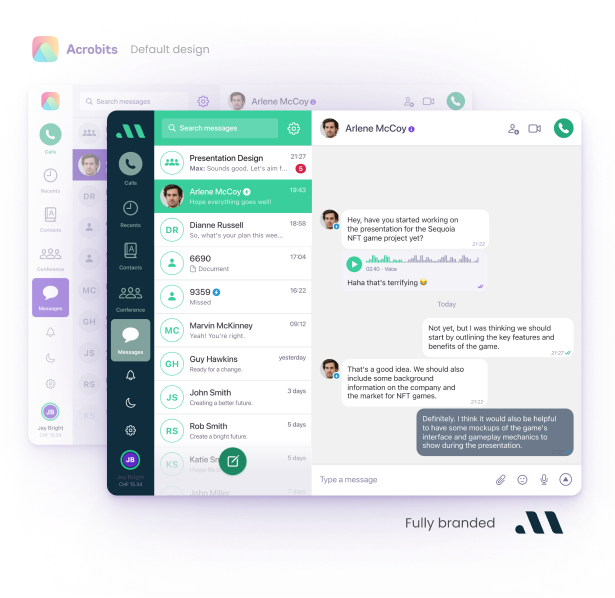
Create a custom white-label softphone with Cloud Softphone.

The history of VoIP is full of clever hacks. Solutions that started as stopgaps, even kludges, often ended up becoming the standard way of doing things. One of the best examples is push notifications for incoming calls on softphones. What began as a workaround has become the only accepted method on mobile platforms. And Acrobits […]

Android’s greatest strength, its openness and vast device diversity, has also created its most persistent challenge for developers: fragmentation. While Apple’s iOS universe is carefully curated, Android is free to roam across more than 20,000 device types. This means every launch is met by confronting a maze of device-specific quirks, platform evolutions, and new compliance […]

The Customer Acquisition Challenge In today’s digital marketplace, ESIM providers face an increasingly difficult challenge when it comes to customer acquisition. As the industry matures, competition for keywords in digital advertising has intensified dramatically, resulting in higher customer acquisition costs across the board. Major players and emerging startups alike find themselves trapped in bidding wars […]

With more businesses relying on softphones for internal and external communication, the security of your VoIP system has never been more critical. As VoIP adoption grows, so do threats like VoIP hacks, toll fraud, and denial-of-service attacks, putting your business communications and data at risk. To stay protected, it’s essential to implement tools like SBCs […]